Art: School-16112022_720p.mp4
We make travel easy for Travelers, Students, Digital Nomads and Travel Agents
We have helped more than 1 000 000 travellers and 200+ Travel and Visa agents
Flight Reservation
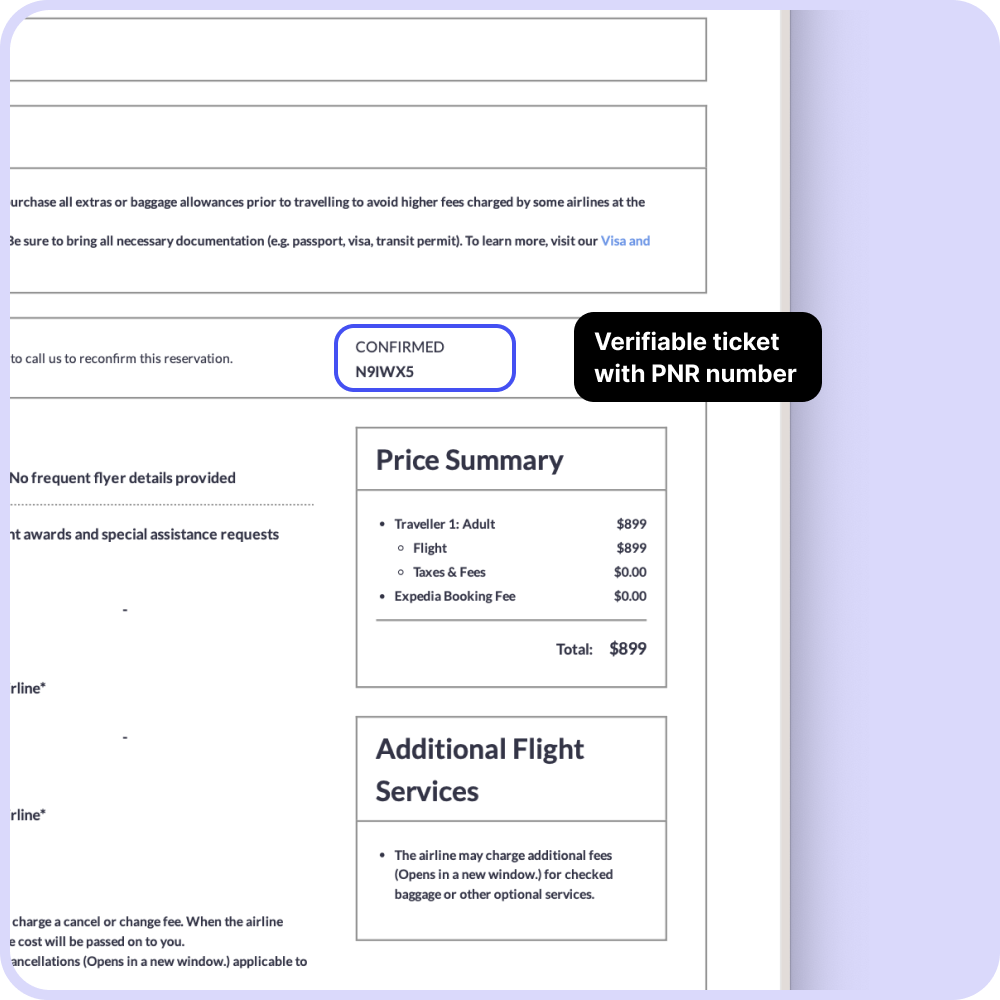
Flight bookings with a verifiable PNR number can help travelers obtain a visa and enter a country. The PNR is a unique identifier that can verify a ticket has been booked and show proof of plans to leave the country. This can help make entry into a country stress-free.
Reservation can be checked on the airline's website or GDS, such as checkmytrip.com or viewtrip.travelport.com
- Verifiable ticket with PNR number
- Reservation code will be valid for a maximum of 14 days
- One ticket may include up to 4 passengers
- You will receive your ticket within 24 hours
Get Flight Reservation
Sample ticket
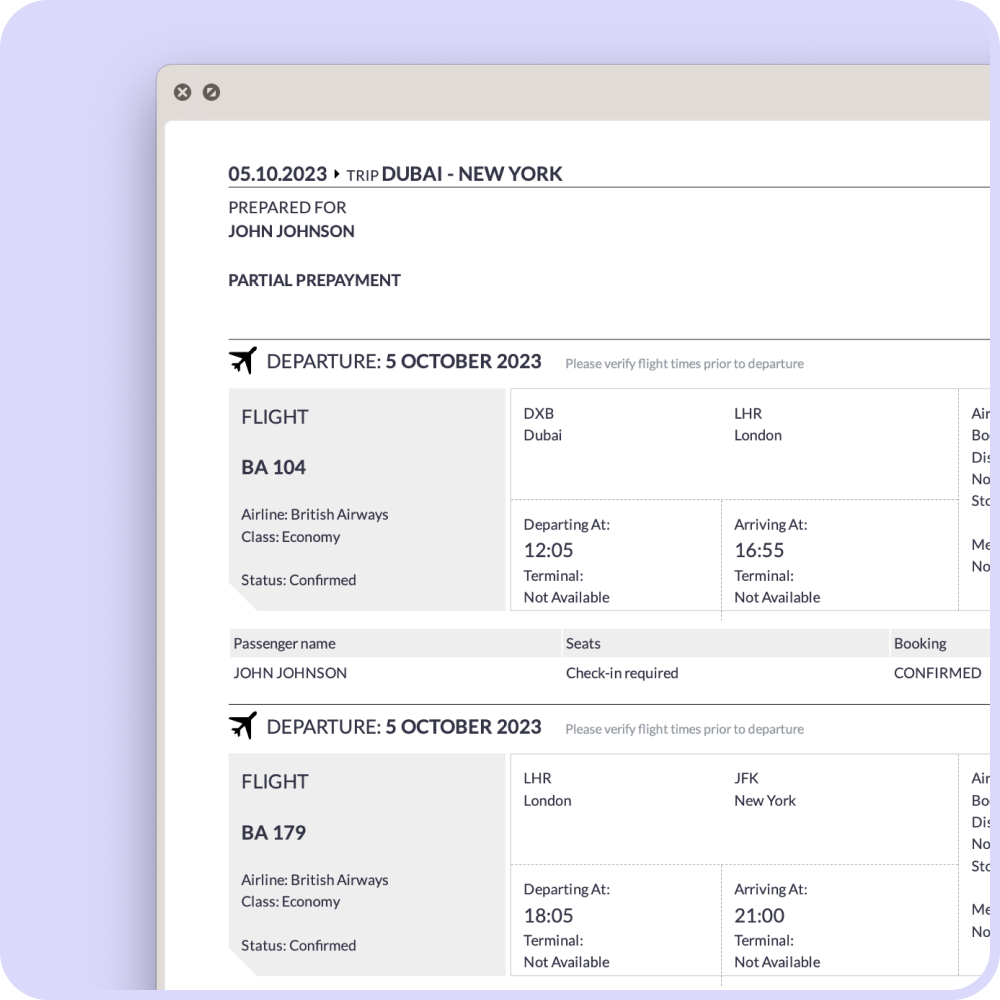
A sample/onward/dummy ticket is a ticket for a future flight. It looks like a real ticket, but it does not have a PNR code, meaning it is not verifiable.
- Instant flight ticket creation
- With a flight price on a ticket
- Non verifiable ticket
Try for Free
Examples of usage
Travel Visa
Onward Ticket
Business Trip Confirmation
Travel Agency
Travel Visa
In many cases, a flight reservation is an important aspect of the visa application process, as it can provide evidence that you have concrete plans to travel. By having a flight reservation, the issuing authority can better assess the applicant's intent to travel, as well as their ability to pay for the flight and other related expenses. Ultimately, a flight reservation can be a useful tool for visa applicants, as it can help demonstrate their commitment to traveling and complying with visa regulations.
Onward Ticket
It's a common requirement, and many countries require travelers to present a flight reservation or ticket for their onward journey when they arrive. This helps to demonstrate that the traveler has the financial means to pay for the journey and that they have a definite plan for their stay. It can also help authorities feel more secure in the knowledge that the traveler will not overstay their allotted time in the destination country.
Art School-16112022_720p.mp4
Business Trip Confirmation
It's a common requirement that many organizations have when booking a business trip, as they want to make sure that you are actually scheduled to fly and that you will be present for the duration of the trip. Having a flight reservation is a way of providing this confirmation and is often used in the process of obtaining a visa or other travel documents. It's important to keep in mind that having a flight reservation does not guarantee you a seat on the flight, and you may still need to purchase a ticket to board the plane.
If you’re following along with this series, your
Travel Agency
Our team of experts will work with you to ensure that your clients' flight reservations are confirmed and guaranteed, giving you the peace of mind that comes with a successful visa application. Our fast and efficient service means that you can quickly and easily secure the flight reservations you need, without any hassle. Special prices coming soon.
Whether you're working with digital brushes or physical
Art: School-16112022_720p.mp4
If you’re following along with this series, your "homework" is to take the techniques from this video and apply them to a 30-minute study of a household object. Don't worry about making it pretty—focus on making it accurate .
In this 720p deep-dive, the primary goal was to master [Topic]. Whether you're working with digital brushes or physical charcoal, understanding how [Topic] interacts with a canvas is the "secret sauce" of realism. Key Takeaways from the Session:
Many artists hit a plateau because they skip the "boring" basics. This session was a challenge to return to those roots. By slowing down and focusing on [specific technique mentioned in video], we're building the muscle memory needed for more ambitious projects down the road. What’s Next?
We spent the first twenty minutes just sketching basic forms. It’s a reminder that even the most complex portraits start with simple circles and squares.
This looks like a specific video file from your personal collection or a specific course. Since I can’t "watch" the file directly through the filename, I’ve put together a flexible blog post template based on common "Art School" themes.
One of the biggest "aha" moments in the video is seeing how a single highlight can completely change the depth of a subject.
As the date 16-11-2022 reminds us, progress is a timeline. Comparing work from then to now shows just how much "milage" matters in art. Why This Lesson Matters
Art isn't just about the final masterpiece; it’s about the messy, disciplined, and rewarding process of learning to see the world differently. In our latest session, captured in , we dove deep into the fundamentals that turn a hobbyist into a technician. The Focus: [Insert Topic, e.g., Light and Shadow]
What our customers say
MESSAGES
Andrea Botez
I made a reservation for $21,90. There were no problems with this ticket at the border control.
MESSAGES
Anna Darovski
Very fast in delivering services ⚡
MESSAGES
Marijana
Hi, I bought a ticket on this site 2 days ago. The guys helped to make a difficult reservation, although they warned that the reservation could only work for a couple of days.
MESSAGES
Artem Svirchevskiy
Everything went amazing! I wasn't too nervous when an airline employee checked the return ticket by checking my booking number. I was flying to Thailand before Christmas and didn't want to get stuck at such a crazy time when tickets cost overprices. Booked on a key flight for just $21,90, and it's worth it. Thanks to the service and its creators.
If you’re following along with this series, your "homework" is to take the techniques from this video and apply them to a 30-minute study of a household object. Don't worry about making it pretty—focus on making it accurate .
In this 720p deep-dive, the primary goal was to master [Topic]. Whether you're working with digital brushes or physical charcoal, understanding how [Topic] interacts with a canvas is the "secret sauce" of realism. Key Takeaways from the Session:
Many artists hit a plateau because they skip the "boring" basics. This session was a challenge to return to those roots. By slowing down and focusing on [specific technique mentioned in video], we're building the muscle memory needed for more ambitious projects down the road. What’s Next?
We spent the first twenty minutes just sketching basic forms. It’s a reminder that even the most complex portraits start with simple circles and squares.
This looks like a specific video file from your personal collection or a specific course. Since I can’t "watch" the file directly through the filename, I’ve put together a flexible blog post template based on common "Art School" themes.
One of the biggest "aha" moments in the video is seeing how a single highlight can completely change the depth of a subject.
As the date 16-11-2022 reminds us, progress is a timeline. Comparing work from then to now shows just how much "milage" matters in art. Why This Lesson Matters
Art isn't just about the final masterpiece; it’s about the messy, disciplined, and rewarding process of learning to see the world differently. In our latest session, captured in , we dove deep into the fundamentals that turn a hobbyist into a technician. The Focus: [Insert Topic, e.g., Light and Shadow]